


Surviving cancer changes the way people think about both life and health.
If for months, or even years, every one of your decisions revolved around treatment, appointments, and getting through the next stage of recovery, and then a healthier chapter begins, it’s time to prioritize your strength, mobility, and quality of life by reinforcing what your body is capable of now.
Increasingly, researchers are discovering that recovery from cancer doesn't end when treatment does. The body continues adapting, rebuilding, and responding to its environment throughout life. This understanding has helped advance the field of regenerative health and inspired ongoing research into technologies such as micro impact therapy, which are designed to work alongside the body's natural adaptive processes. [3]
How Cancer Treatment Can Affect Bone Health
Childhood and adolescence are the years when the body builds the strongest skeleton it will ever have. The more bone that's built during this period, the stronger the foundation for lifelong skeletal health.
For many pediatric cancer survivors, however, that process is disrupted. According to Juvent's clinical review, nearly half experience impaired bone mineralization that can persist into adulthood, largely because of the combined effects of the disease itself, chemotherapy, radiation, reduced physical activity, and nutritional challenges. These changes can affect bone mineral density and the body's ability to maintain long-term skeletal health. [1,4]
Scientists now recognize that the skeleton is more than a structural framework. Bone plays an essential role in blood cell production, hormone regulation, and overall physical function. Supporting bone health therefore contributes to much more than stronger bones alone. It also helps lay the foundation for lifelong mobility, metabolic health, and quality of life. [4]
What Is Micro Impact Therapy?
One of the most exciting discoveries in regenerative science is that, in addition to nutrition and biochemistry, the body also responds to carefully controlled mechanical forces. Every step we take generates tiny mechanical signals that bone cells recognize and respond to by influencing the natural processes involved in bone remodeling, repair, and adaptation. This field of research, known as mechanobiology, has transformed how scientists understand bone remodeling, tissue adaptation, and the body's remarkable ability to respond to physical movement. [3]
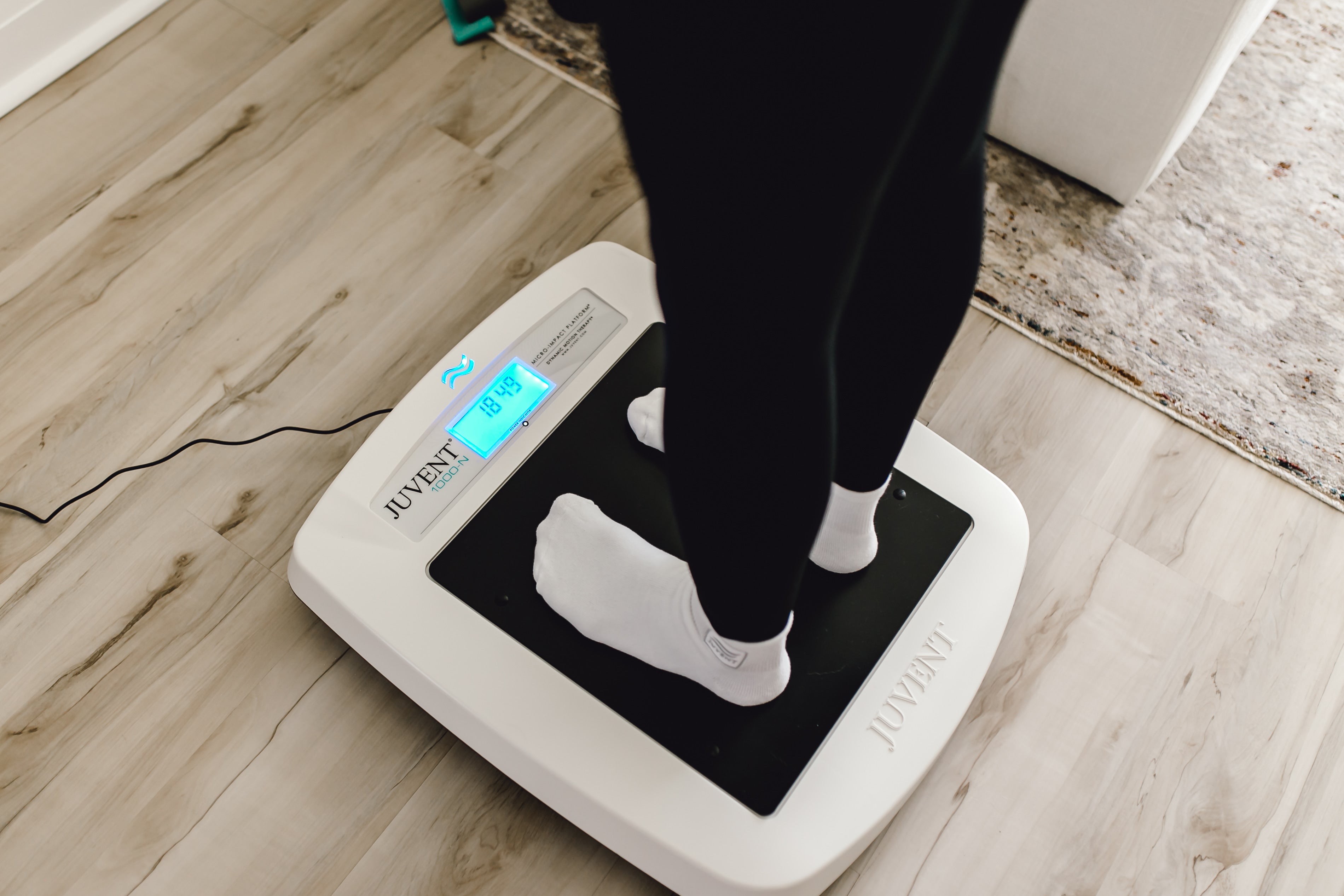
Micro impact therapy is based on this principle. Rather than relying on the larger movements and higher forces commonly associated with many conventional vibration platforms, micro impact therapy delivers carefully controlled, low-magnitude mechanical stimulation through the feet while an individual stands on a specialized platform. Researchers have investigated this approach because mechanical loading plays an important role in bone remodeling and may help encourage stem cells to develop into bone-building cells through a process known as osteoblastogenesis. [2,3]
Developed through more than $45 million in research and development and protected by more than 20 worldwide patents, Juvent's patented Micro-Impact Platform® combines intelligent software, a high-resolution accelerometer, and precision engineering to optimize personalized mechanical stimulation suited to each individual user. According to Juvent's technical documentation, the platform delivers precisely controlled micro-impacts of approximately 0.3g by automatically adjusting to each user's natural resonant frequency. [4]
Can You Use a Vibration Plate When You Have Cancer?
One of the most common questions people ask is whether a vibration machine is appropriate after a cancer diagnosis.
The answer depends on the individual's medical circumstances and the type of technology being considered. Researchers carefully distinguish between controlled low-magnitude mechanical stimulation and conventional whole-body vibration platforms because marked differences in force, signal delivery, and engineering design may influence biological responses. [3,4]
One randomized, placebo-controlled clinical trial published in JAMA Oncology investigated low-magnitude mechanical stimulation technology in pediatric cancer survivors with reduced bone mineral density. Researchers reported improvements in total body and tibial bone mineral density among participants assigned to the active device, while children in the placebo group experienced declines. Among participants who completed at least 70% of their prescribed sessions, tibial trabecular bone mineral density increased by a mean of 11.2%. The investigators also observed a correlation between circulating osteocalcin, a marker of bone formation, and improvements in total body bone mineral density. No adverse events associated with the low-magnitude mechanical stimulation intervention were reported during the year-long study. [1]
Although these findings are encouraging, they are based on a single carefully designed clinical study in a specific patient population. Researchers continue to investigate how low-magnitude mechanical stimulation may support long-term skeletal health as part of an overall recovery strategy for cancer survivors.
Any rehabilitation or recovery program should always be discussed with the individual's oncology team and healthcare providers.
The Connection Between Bone Health and Quality of Life
In addition to supporting the body, strong bones provide the foundation for movement, stability, independence, and many of the everyday activities that contribute to quality of life.
Researchers continue to investigate how carefully controlled mechanical stimulation may support the biological processes involved in bone remodeling, tissue adaptation, and musculoskeletal health. This growing body of research reflects current advancements and a new focus in regenerative science: supporting the body's natural capacity to adapt rather than focusing solely on the treatment of disease. [2,3]
Juvent's patented Micro-Impact Platform therapy was developed around this understanding, translating decades of scientific investigation into a technology designed to work alongside the body's own adaptive systems. As research continues to evolve, controlled mechanical stimulation may become an increasingly valuable component of an overall bone health and recovery strategy. [4]
To learn more about Juvent's Micro-Impact Platform®, visit our FAQs page for answers to common questions, or contact our team directly. We're here to help you better understand the science and whether our technology may be right for you.
References
1. Mogil RJ, Kaste SC, Ferry RJ Jr, Hudson MM, Mulrooney DA, Howell CR, Partin RE, Srivastava DK, Robison LL, Ness KK. Effect of Low-Magnitude, High-Frequency Mechanical Stimulation on Bone Mineral Density Among Young Childhood Cancer Survivors: A Randomized Clinical Trial. JAMA Oncology. 2016;2(7):908-914. doi:10.1001/jamaoncol.2015.6557.
2. Chow DHK, Leung KS, Qin L, Leung AHC, Cheung WH. Low-Magnitude High-Frequency Vibration Enhances Bone Remodeling in Osteoporotic Rat Femoral Fracture Healing. Journal of Orthopaedic Research. 2011;29(5):746-752. doi:10.1002/jor.21303.
3. Nagaraja MP, Jo H. The Role of Mechanical Stimulation in Recovery of Bone Loss—High versus Low Magnitude and Frequency of Force. Life. 2014;4(2):117-130. doi:10.3390/life4020117.
4. Juvent Medical Inc. Clinical Benefits of Juvent's Micro-Impact Platform®. JR300329-Rev.1. 2019.
Source Note
Product specifications, platform characteristics, engineering information, clinical summary data, and technology descriptions relating to Juvent's Micro-Impact Platform® were derived from Clinical Benefits of Juvent's Micro-Impact Platform® (JR300329-Rev.1, 2019) and associated Juvent technical materials.
Sources
- A Brief Review of Bone Cell Function and Importance, Cells. [https://pmc.ncbi.nlm.nih.gov/articles/PMC10648520/]
- Bone Health and Its Connection with Health and Longevity, Healthy Longevity Clinic.
- Effect of Low-Magnitude, High-Frequency Mechanical Stimulation on Bone Mineral Density Among Young Childhood Cancer Survivors: A Randomized Clinical Trial, JAMA Oncology. [https://jamanetwork.com/journals/jamaoncology/fullarticle/2499778]
- Low-Magnitude High-Frequency Vibration Enhances Bone Remodeling in Osteoporotic Rat Femoral Fracture Healing, Journal of Orthopaedic Research. [https://doi.org/10.1002/jor.21303]
- The Role of Mechanical Stimulation in Recovery of Bone Loss—High versus Low Magnitude and Frequency of Force, Life. [https://pubmed.ncbi.nlm.nih.gov/25370188/]

Get the latest insights and contents on all things bone and body health. Signup for our newsletter!
Share:
What Is Low-Magnitude Mechanical Stimulation? The Science Behind Regenerative Health and Healthy Longevity
Aging Powerfully Starts Earlier Than You Think