


Regenerative health may sound like the stuff of science fiction, but its foundations were laid decades ago through one of medicine's most important discoveries. In the 1960s, scientists studying bone marrow identified potent cells capable of rebuilding the body's blood system. That work ultimately led to the development of bone marrow transplantation and, later, the field we now know as regenerative medicine. Over the following decades, advances in stem cell biology, tissue engineering, and mechanobiology transformed what once seemed futuristic into an active and rewarding area of scientific research.
Today, regenerative health is an approach that goes beyond simply managing symptoms. It focuses on supporting the body's natural ability to repair, replace, and maintain healthy cells, tissues, and organs. Rather than concentrating solely on treating illness after it develops, regenerative health seeks to preserve and restore healthy biological function throughout life.
One of the most fascinating discoveries to emerge from this field is that the body doesn't rely on chemistry alone to regulate these processes. It also responds to physical forces. Every step we take, every staircase we climb, and every movement we make generates tiny mechanical cues that our cells are designed to recognize. Scientists now understand that mechanical loading plays an important role in how bone remodels (the body breaks down and absorbs old and damaged bone tissue, then replaces it with new, healthy bone), how tissues adapt, and how the musculoskeletal system maintains its strength over time. [1,2]
How Your Body Regenerates
The body’s natural regeneration processes occur every day. Bone is constantly being broken down and rebuilt through remodeling. Muscles repair after exercise, blood vessels adapt to changing demands, and stem cells help replenish and maintain healthy tissues. The human body is not static but continually responds to its environment.
Scientists now recognize that these regenerative processes are influenced not only by genetics, hormones, and nutrition, but also by physical forces. The field of mechanobiology explores how cells detect and respond to mechanical loading, revealing that everyday movements generate important biological signals that help regulate tissue adaptation. Walking, climbing stairs, resistance exercise, and other forms of weight-bearing activity all generate mechanical stimulation that helps guide healthy musculoskeletal adaptation. [1,2]
This understanding has fundamentally changed how researchers think about healthy aging. Rather than viewing bone loss, declining mobility, and reduced physical resilience as inevitable consequences of growing older, scientists increasingly recognize that the body continues responding to meaningful mechanical input throughout life.
What Is Low-Magnitude Mechanical Stimulation?
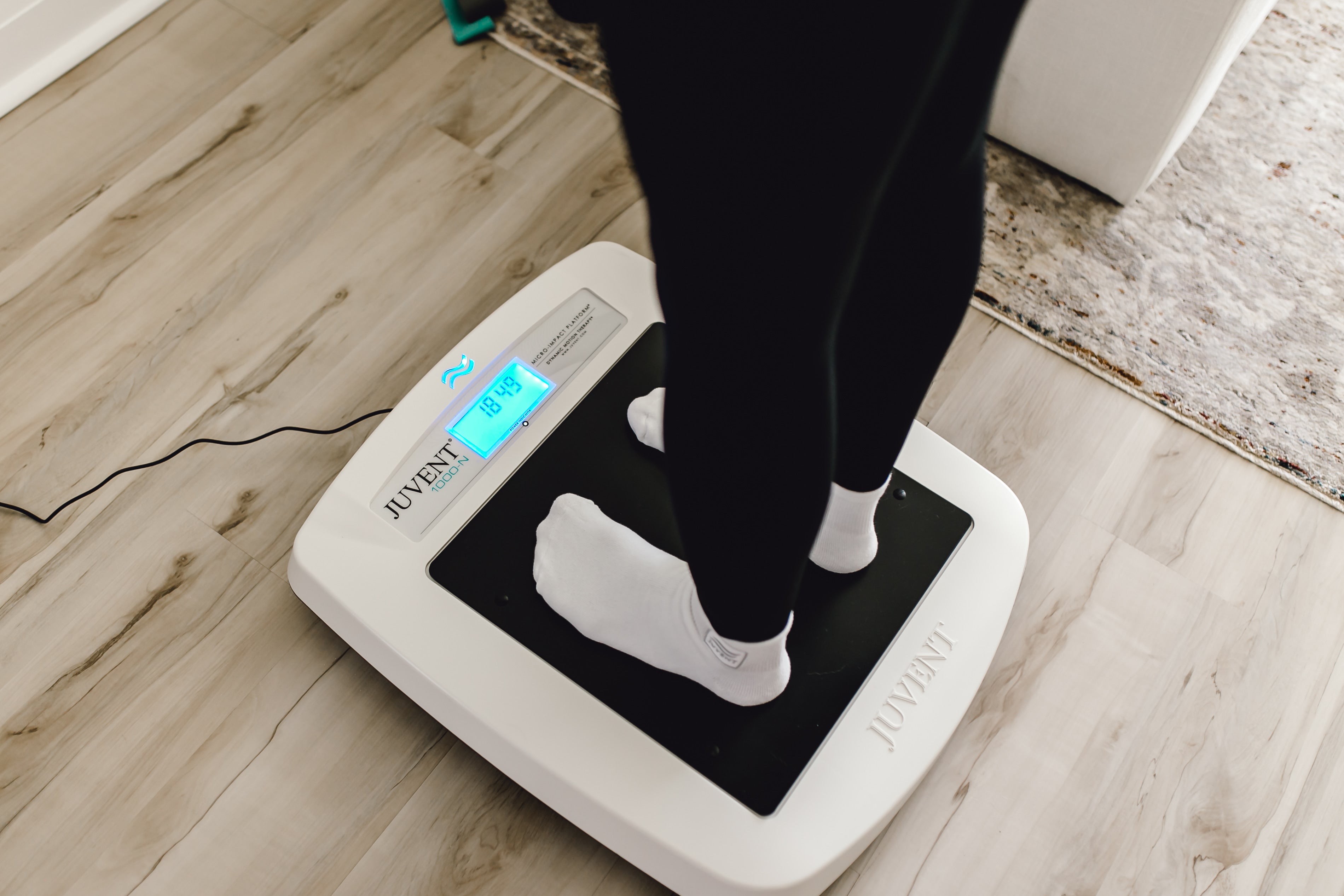
Low-magnitude mechanical stimulation (LMMS) is a carefully controlled form of mechanical loading that can be delivered through the feet while standing on a specialized, vibrating platform. Unlike conventional vibration technologies that often rely on larger movements and higher forces (often risky or dangerous), LMMS delivers gentle, high-frequency mechanical stimulation designed to remain within the body's natural physiological range. [10]
Developed through more than $45 million in research and protected by more than 20 worldwide patents, Juvent's patented Micro-Impact Platform® was engineered to deliver controlled, low-magnitude mechanical stimulation optimized for each individual user. According to our technical documentation, the platform combines intelligent software, a high-resolution accelerometer, and precision mechanics to optimize mechanical stimulation for each individual user. It delivers controlled micro-impacts of approximately 0.3g, enabling consistent mechanical signal delivery while remaining well below the force levels commonly associated with conventional whole-body vibration technologies. [10]
The objective is to deliver carefully controlled mechanical cues that the body's cells are already designed to recognize. Researchers continue to investigate how these subtle signals influence biological pathways involved in tissue maintenance, adaptation, and repair.
Why Researchers Are Interested in Mechanical Stimulation
Interest in LMMS extends beyond bone density alone. Researchers have investigated controlled mechanical stimulation for its potential to influence biological processes involved in bone remodeling, angiogenesis, stem cell differentiation, fracture healing, and musculoskeletal adaptation. Laboratory studies suggest that low-magnitude mechanical signals may encourage stem cells to develop into bone-forming cells while supporting healthy mineralization and tissue remodeling. [1-5]
These biological mechanisms have led scientists to explore LMMS across a wide range of clinical settings. Studies have investigated its potential role in osteoarthritis, rheumatoid arthritis, fracture healing, pediatric Crohn's disease, metabolic disorders, and conditions associated with reduced bone mass. While findings differ across populations and study designs, decades of research continue to build our understanding of how carefully controlled mechanical stimulation may support the body's natural adaptive processes. [3-9]
For example, studies examining osteoporotic fracture healing reported enhanced callus formation, mineralization, and remodeling following exposure to low-magnitude, high-frequency mechanical stimulation. Other investigations have demonstrated increased recruitment of mesenchymal stem cells during fracture repair, highlighting growing interest in understanding how mechanical signals influence cellular regeneration. [3-5]
Clinical investigations in people with rheumatoid arthritis have reported improvements in functional ability and fatigue, and have demonstrated preservation of hip bone mineral density compared with controls in some study populations. Disease activity itself did not significantly change. [6,7]
Meanwhile, a randomized placebo-controlled trial involving children with Crohn's disease found improvements in vertebral trabecular bone mineral density among participants with greater adherence to treatment. Collectively, these studies illustrate a breadth of ongoing research rather than establishing a single application for LMMS. [6-9]
How Often Should You Use an LMMS Platform for Bone Density?
Although many people use the term "vibration plate" when searching online, researchers distinguish between conventional whole-body vibration platforms and low-magnitude mechanical stimulation (LMMS) technologies because the magnitude, frequency, and delivery of the mechanical signal can differ substantially. Those differences may influence biological response and are an important reason why individual research findings should be interpreted in the context of the specific technology being studied. [10]
People also ask how often an LMMS platform should be used to support bone health. The answer depends on the technology being studied. Research protocols vary considerably according to the health condition being investigated, the characteristics of the participants, and the design of the device itself. Clinical studies involving LMMS evaluate different treatment durations and frequencies. [6-9]
For Juvent's Micro-Impact Platform®, the recommended protocol is 15 to 20 minutes 3 to 5 times per week, or as your physician recommends, reflecting the platform's engineering and the company's intended use guidance. More is not always better. There is a point at which the cells can no longer respond; they need a rest. Rather than simply increasing exposure time, the platform is designed to deliver carefully controlled, low-magnitude mechanical stimulation consistently within its intended operating parameters. [10]
Perhaps more importantly, researchers increasingly recognize that duration is only one part of the equation. The magnitude of the mechanical signal, the consistency of its delivery, and its interaction with the body's natural biomechanics all influence biological responses. This helps explain why not all vibration-based technologies should be viewed as equivalent, and why scientists continue to carefully distinguish controlled LMMS from conventional whole-body vibration systems. [10]
How to Age More Powerfully: Supporting the Body’s Natural Adaptive Processes
Healthy aging is rarely the result of a single intervention. Instead, it reflects the cumulative effects of countless biological responses taking place every day throughout our lives. Regular movement, balanced nutrition, a healthy endocrine system, restorative sleep, and other healthy habits for longevity all help maintain strong bones, resilient muscles, and healthy connective tissues.
Increasingly, researchers are exploring whether controlled mechanical stimulation may be another meaningful factor in how our cells respond to the environment around us. Rather than attempting to replace the body's natural biology, LMMS was developed to work alongside it, delivering gentle mechanical signals that healthy tissues are already designed to detect and respond to. [1,2,10]
Juvent's Micro-Impact Platform® was developed from decades of scientific investigation into mechanobiology and tissue adaptation. Backed by extensive research and engineering, the platform’s role is to translate advances in regenerative science into an accessible device that supports the body's natural adaptive processes. [10]
As research into regenerative science continues to evolve, carefully controlled mechanical stimulation may become an increasingly important part of healthy longevity. Because when it comes to aging powerfully, it's never too early to support the regenerative systems already at work in your body.
Learn more about the Juvent Micro-Impact Platform® by consulting our FAQs page. Contact Juvent for additional information.
References
-
Rubin CT, Capilla E, Luu YK, et al. Adipogenesis is inhibited by brief, daily exposure to high-frequency, extremely low-magnitude mechanical signals. Proceedings of the National Academy of Sciences of the United States of America. 2007;104(45):17879-17884.
-
Jing D, Luo E, Cai J, Tong S, Zhai M, Shen G, Wang X, Luo Z. Mechanical vibration mitigates the decrease of bone quantity and bone quality of leptin receptor-deficient db/db mice by promoting bone formation and inhibiting bone resorption. Journal of Bone and Mineral Research. 2016;31(4):833-841.
-
Chung SL, Leung KS, Cheung WH. Low-magnitude high-frequency vibration enhances gene expression related to callus formation, mineralization, and remodeling during osteoporotic fracture healing in rats. Journal of Orthopaedic Research. 2014;32(12):1572-1579.
-
Chow DHK, Leung KS, Qin L, Leung AH, Cheung WH. Low-magnitude high-frequency vibration enhances bone remodeling in osteoporotic rat femoral fracture healing. Journal of Orthopaedic Research. 2011;29(5):746-752.
-
Wei FY, Chow SK, Leung KS, Qin J, Guo A, Yu OL, Li G, Cheung WH. Low-magnitude high-frequency vibration enhanced mesenchymal stem cell recruitment in osteoporotic fracture healing through the SDF-1/CXCR4 pathway. European Cells and Materials. 2016;31:341-354.
-
Prioreschi A, Tikly M, McVeigh JA. A three-month controlled intervention of intermittent whole-body vibration designed to improve functional ability and attenuate bone loss in patients with rheumatoid arthritis. BMC Musculoskeletal Disorders. 2014;15:403.
-
Prioreschi A, Makda MA, Tikly M, McVeigh JA. Positive effects of a randomized three-month whole-body vibration therapy intervention on functional ability, bone mineral density, and fatigue are sustained for up to six months in patients with established rheumatoid arthritis. PLoS ONE. 2016;11(4).
-
Leonard MB, Shults J, Long J, et al. Effect of low-magnitude mechanical stimuli on bone density and structure in pediatric Crohn's disease: A randomized placebo-controlled trial. Journal of Bone and Mineral Research. 2016;31(6):1177-1188.
-
Wu SH, Zhong ZM, Chen JT. Low-magnitude high-frequency vibration inhibits RANKL-induced osteoclast differentiation of RAW264.7 cells. International Journal of Medical Sciences. 2012;9(9):801-807.
-
Juvent. Clinical Benefits of Juvent's Micro-Impact Platform®. JR300330-Rev2. Juvent Medical Inc.; 2019.
Source Note
Product specifications, platform design, engineering characteristics, and descriptions of Juvent's Micro-Impact Platform® were derived from Clinical Benefits of Juvent's Micro-Impact Platform® (JR300330-Rev2) and associated Juvent technical materials.

Get the latest insights and contents on all things bone and body health. Signup for our newsletter!
Share:
Micro-Impact Therapy vs. Whole-Body Vibration: What the Research Reveals About Safety and Effectiveness
How Micro-Impact Therapy May Support Strength, Mobility, and Quality of Life for Cancer Survivors