


The breakthroughs being made in regenerative health and longevity technology are exciting. As we age, declining bone health and overall wellness are no longer inevitable. At the same time, however, there's a significant amount of conflicting information surrounding vibration platforms and their ability to deliver the precise mechanical stimulation being studied for its role in tissue repair, bone health, and the body's natural regenerative processes.
Some platforms operate as high-amplitude shakers that may not be appropriate for older adults, individuals with mobility issues or osteoporosis, and those who are not in high athletic condition. Low-magnitude mechanical stimulation delivered by clinically engineered micro-impact platforms sends precise, individually calibrated vibrations throughout the body, supporting the body's natural regenerative processes through mechanotransduction, a process in which cells convert mechanical forces into biochemical signals involved in tissue maintenance and repair.
While both types of platforms use whole-body vibration, they generate very different mechanical signals and are designed with different therapeutic goals in mind. Factors such as vibration frequency, amplitude, acceleration, and duration all influence vibration plate benefits. High-amplitude fitness platforms emphasize vigorous muscle activation and movement, which can lead to microtears and lower back pain, whereas low-intensity mechanical stimulation is engineered to deliver subtle, repeatable signals that have been studied in clinical settings.
Understanding these differences is essential because, despite looking similar, not all vibration platforms are the same.
How the Body Responds to Mechanical Stimulation
The body is constantly responding to mechanical forces. Specialized bone cells called osteocytes detect these forces and convert them into biochemical signals that regulate bone remodeling, helping maintain healthy bone throughout life. Walking, climbing stairs, lifting a bag of groceries, and dancing all generate mechanical forces that are translated into cellular signals through a process known as mechanotransduction. This cellular response to physical loading forms the foundation of mechanobiology, an area of research exploring how mechanical forces influence human biology.
Researchers are exploring how appropriately dosed mechanical stimulation may support the body's natural cellular regeneration processes by activating biological signaling pathways involved in tissue maintenance and repair.
From Cellular Mechanobiology to Regenerative Rehabilitation
The discovery that cells actively respond to mechanical forces laid the foundation for an emerging field of study known as regenerative rehabilitation, which works hand in hand with regenerative medicine. Regenerative rehabilitation combines biomechanics, rehabilitation science, tissue engineering, and mechanobiology to better understand how physical forces influence the body's ability to heal. The goal is to leverage carefully controlled mechanical stimulation to optimize the body's natural healing processes.
Researchers now know that mechanical signals influence not only individual cells but also the stem-cell environment and the extracellular matrix (the complex network of proteins and molecules that surrounds and supports every cell in the body). Together, these systems regulate how tissues respond to stress, communicate, and recover following injury. By encouraging these natural biological processes, optimized mechanical stimulation may help support tissue repair, maintain musculoskeletal health, and contribute to healthy aging by helping the body preserve its structure and function over time.
What Is the Difference Between Low-Intensity Vibration and Intense Shaker Plates?
Not all vibration devices produce the same type of mechanical stimulation. Low-intensity mechanical stimulation delivers carefully engineered frequencies for extremely small displacements. These platforms are designed to stimulate the body’s natural biological processes rather than aggressively shake the body. By providing calibrated vibrations that don't exceed the body's low-magnitude mechanical loading range, they are intended for regular daily use.
This type of whole-body vibration therapy is based on clinically studied parameters. Many commercial whole-body vibration plates (WBV), on the other hand, often aim to enhance muscle strength, power, and athletic performance. They deliver higher frequencies, amplitudes, and accelerations than low-intensity therapeutic devices. Current findings suggest that the evidence is insufficient to provide clear and generalized recommendations regarding the efficacy of WBV in improving athletes’ exercise performance.
While these machines may be appropriate for some exercise programs, they are not based on the same engineering principles or clinical objectives as low-intensity therapeutic devices.
Why Precise Mechanical Stimulation Is a Key Differentiator
The science behind mechanical stimulation continues to reinforce the idea that more isn't necessarily better. The body doesn't simply respond to stronger forces; it responds to the right forces delivered at the right magnitude. This is why precision has become such an important consideration in the development of technologies designed to support bone health, mobility, and healthy aging.
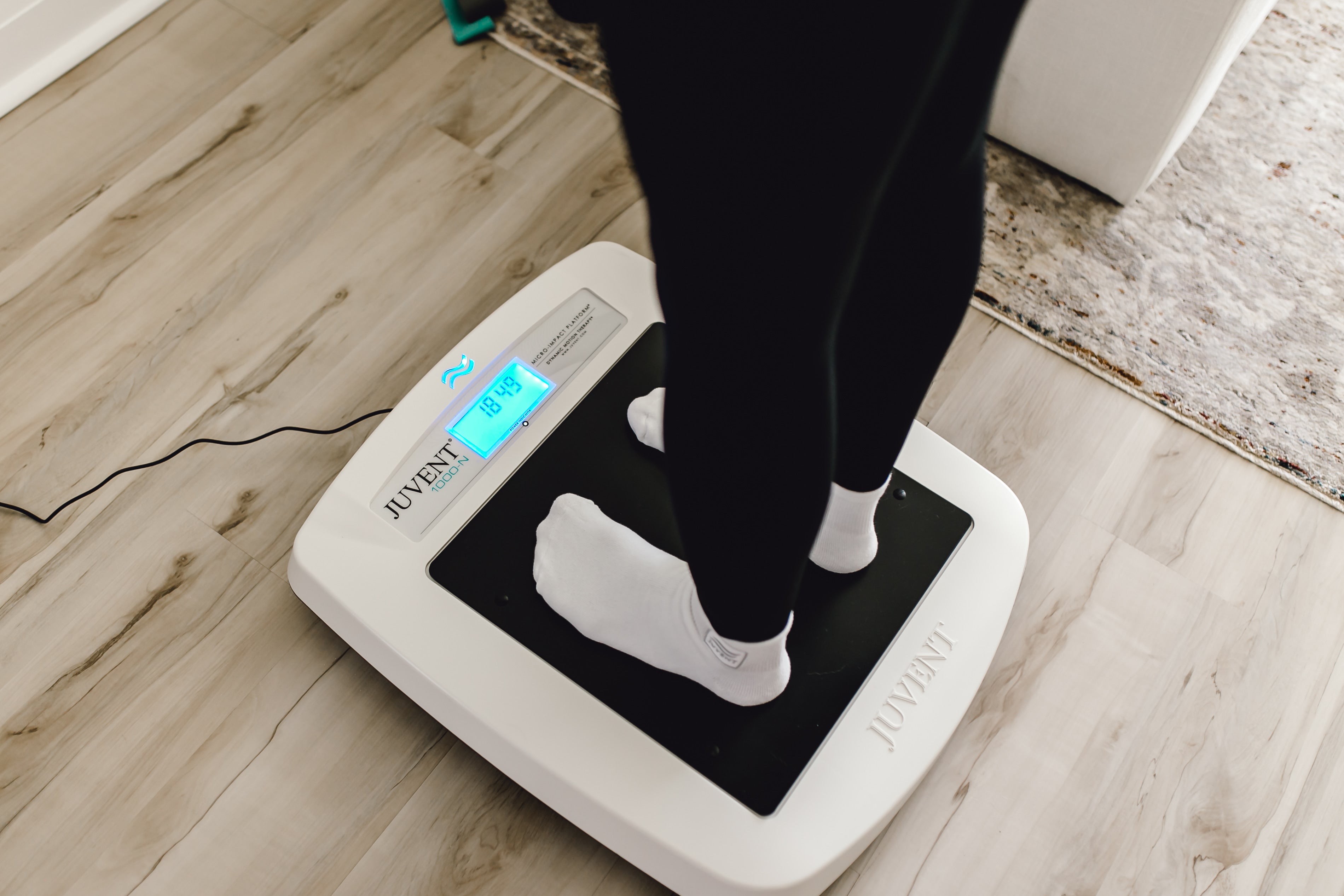
The Juvent Micro-Impact Platform® was engineered around this principle. Rather than relying on vigorous shaking, it delivers precisely calibrated, low-intensity mechanical signals that have been evaluated in clinical research. These subtle micro-impacts are designed to work with the body's natural biological processes, encouraging mechanotransduction without subjecting joints, connective tissues, or the spine to unnecessary mechanical loading.
For individuals looking to invest in long-term bone health and overall wellness, understanding these engineering differences between shaker plates and Juvent’s Micro-Impact Platform can help separate marketing claims from clinically informed design.
Supporting Your Body’s Natural Ability to Heal and Thrive
As regenerative health continues to evolve, one thing has become increasingly clear: the body is remarkably responsive to carefully applied mechanical forces. Choosing a vibration platform shouldn't come down to which machine is the cheapest and shakes the hardest, but rather which one has been engineered to deliver the type of mechanical stimulation supported by scientific research.
If you're looking for a clinically engineered approach to supporting bone health, mobility, and healthy aging, the Juvent Micro-Impact Platform offers a fundamentally different approach.
Consult our FAQs page or contact the Juvent team today to learn how low-intensity mechanical stimulation can help support your body's natural regenerative processes and find out whether this is the right solution for your health and wellness goals.
FDA Disclosure
In the US, the Juvent device is considered investigational for the treatment of osteoporosis or improvement/maintenance of bone mineral density, and our claims have not been reviewed or cleared by the FDA to treat any disease or condition. The JUVENT® Micro-Impact Platform® is registered as a Class I medical device for exercise and rehabilitation.
Sources:
-
Whole Body Vibration Side Effects & Contraindications | Who Should Not Use a Vibration Plate [https://melioguide.com/osteoporosis-treatment/whole-body-vibration-therapy-contraindications/]
-
New Musculoskeletal Health study cautions use of whole-body vibration platforms [https://www.youtube.com/watch?v=jIrCiqhpfPk&t=23s]
-
Osteocyte Mechanobiology and Pericellular Mechanics [https://www.annualreviews.org/content/journals/10.1146/annurev-bioeng-070909-105302]
-
Low mechanical signals strengthen long bones [https://www.nature.com/articles/35088122]
-
Effects of Whole-Body Vibration on Exercise Performance among Athletes: A Systematic Review and Meta-Analysis of Randomized Controlled Trials [https://pmc.ncbi.nlm.nih.gov/articles/PMC12127932/]

Get the latest insights and contents on all things bone and body health. Signup for our newsletter!
Share:
The New Longevity Mindset: Building Capacity Instead of Managing Decline
Your Skeleton Is Alive: Understanding Bone Remodeling Throughout Life