

Vibration plates can look similar while delivering very different kinds of movement. One platform may rock from side to side, another may move vertically, and another may use small mechanical signals with calibration. A photograph, a power rating, or the number of speed settings cannot explain all of those differences. A more useful comparison starts with how a device moves and what the manufacturer can tell you about its intended use.
This interactive vibration plate comparison lets you explore motion patterns, compare disclosed characteristics, and build a shortlist of questions before shopping. It does not identify a medically safe device for your condition. Instead, it helps you understand the specifications and evidence that deserve a closer look. Comfort, practical use, and clinical guidance belong in that conversation alongside the technology itself.
Key Takeaways
- Motion pattern, frequency, amplitude, and acceleration describe different characteristics of vibration.
- More power, more speed settings, or stronger shaking does not automatically mean a better fit.
- Evidence from one device or protocol should not be assumed to apply to every vibration plate.
- Calibration, instructions, support, and ownership terms can matter as much as advertised features.
- A comparison tool can organize product research; it cannot clear someone for vibration use.
Start With the Motion Pattern
Oscillating platforms typically create a side-to-side rocking motion around a central pivot. Synchronous vertical platforms move the supporting surface up and down together. Other designs combine movements or use different mechanical systems. The labels used in retail listings are not always standardized, so a diagram or written description of the actual movement can be more informative than the category name alone.
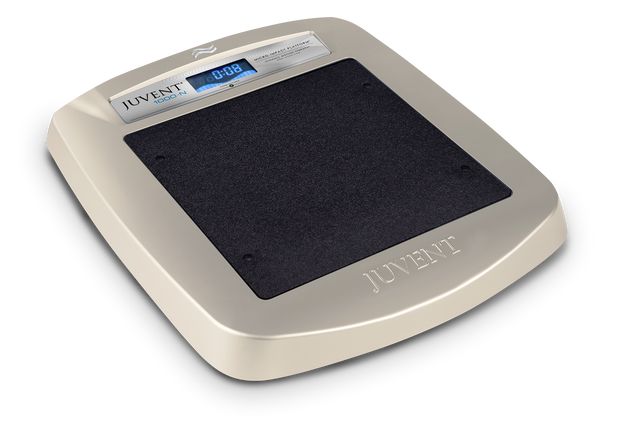
Juvent describes its Micro-Impact Platform as a low-magnitude mechanical stimulation approach with calibration. That distinction is worth investigating, but it does not mean every device in another category behaves identically. The comparison uses category-level descriptions for conventional designs and separately identifies Juvent's disclosed specifications. It avoids inventing a single frequency or acceleration range for all oscillating or vertical platforms.
What Does Frequency Mean?
Frequency describes how often a vibration cycle repeats and is commonly reported in hertz. A frequency setting is not the same thing as a speed level displayed on a remote control. If a product only lists numbered modes, ask whether the manufacturer provides the actual frequencies and explains how those values were measured. Without that information, comparisons may be less precise than they appear.
Frequency should be considered with the movement pattern and displacement. Two devices operating at the same frequency can create substantially different experiences if their amplitudes differ. Similarly, a study using a defined frequency does not validate every platform with a matching number in its advertising. A complete protocol includes more than a single specification, and the way someone stands or exercises may also affect the exposure.
Amplitude and Displacement Need Clear Definitions
Amplitude describes the size of a movement, but manufacturers may use the term differently. Some report displacement from the center to one extreme, while others report the total travel from one extreme to the other. These values are not interchangeable. A useful product page explains the measurement convention and the conditions under which the specification applies, rather than presenting an isolated number.
For a rocking platform, movement can also vary with foot placement. This is another reason to read the instructions instead of assuming that one amplitude describes every possible use. When comparing products, record whether a value is clearly defined, requires clarification, or is not disclosed. A blank field is a question for the manufacturer, not permission to fill the gap with a category average.
Acceleration Is Another Part of the Picture
Acceleration is often expressed relative to gravity using g. It describes an aspect of the mechanical signal and should not be confused with a promise about benefit. A larger acceleration does not establish that a device is more effective, and a lower stated value does not independently prove that a device is suitable for every user. Intended use and individual circumstances still matter.
Juvent's current product information describes a low-magnitude signal around 0.3 to 0.4g, with a frequency range of 32 to 37Hz and very small movement. Those are manufacturer specifications, not a universal standard for every low-intensity device. Check the current model's documentation when purchasing, because specifications and instructions can change. The tool links back to Juvent rather than treating a preview as the final product manual.
What Does Calibration Add to the Comparison?
Calibration deserves its own question because it concerns how a device controls or adjusts delivery. Ask what the system measures, when it makes an adjustment, and whether the manufacturer explains the process. A selectable speed button is not necessarily the same thing as a platform that senses a user and calibrates its mechanical signal. Clear documentation makes those differences easier to evaluate.
Juvent states that its platform calibrates with use to account for the individual. Readers can explore that description alongside the platform's technical information. Calibration should still be discussed within the device's intended use and research. It is not a way to diagnose a condition, verify that an injury has healed, or eliminate the need for guidance when someone has health concerns.
Read Vibration Plate Research More Carefully
Research on whole-body vibration includes varied participants, devices, intensities, session lengths, and outcomes. A study examining balance in older adults is not direct proof that another device treats osteoporosis or improves lymphatic drainage. Start by matching the claim to the outcome measured. Then ask whether the product and protocol being sold resemble the ones used in the research.
It is also useful to distinguish a study from a testimonial. A review can tell you whether an owner found a platform convenient or customer support helpful. It cannot establish that the device caused a medical improvement. In the comparison tool, evidence prompts help you ask for specific studies and intended-use statements rather than assigning a numerical health score to each technology.
Choose Comparison Priorities That Match Your Questions
The priority controls help organize what you want to investigate. If you select signal transparency, the tool emphasizes specifications and measurement definitions. If you select home practicality, it emphasizes placement, access, instructions, and support. If you select research, it highlights study populations and outcomes. These are buying questions, not a medical recommendation or an automatic winner.
For example, someone planning a home exercise routine might want to know whether the platform fits a suitable location and whether the instructions are easy to follow. Someone researching a device after a clinical appointment may first need to ask whether vibration is appropriate at all. Both visitors benefit from a better question list, even though the next step may be different.
Evaluate Ownership Beyond the Initial Purchase
A device needs a realistic place in your home and routine. Review the available space, access requirements, storage, electrical instructions, and manufacturer guidance. Consider who will use it and whether they can follow the intended setup. A product that seems appealing in a demonstration may be less practical if using it consistently requires an inconvenient rearrangement every day.
Ownership also includes warranty terms, return conditions, service availability, and the current instructions. Verify these directly before purchasing. A comparison preview should not make assumptions about eligibility for financing, reimbursement, or a return policy. Keep a short record of the terms relevant to your decision so you can compare options on the same basis rather than relying on a promotional headline.
When to Involve Your Healthcare Professional
Ask for individual guidance if you have osteoporosis, a recent fracture or surgery, unexplained pain or swelling, balance concerns, an implanted device, pregnancy, or another condition that could affect exercise choices. The presence of a condition does not let this tool decide whether vibration is appropriate. Your clinician and the manufacturer's instructions are needed to evaluate the specific situation.
Do not use a platform to test whether a painful joint or injured limb can tolerate loading. Stop and seek appropriate advice if use causes concerning symptoms. A feature described as gentle still represents a mechanical exposure. Reviewing suitability before starting is a practical part of device selection, especially when the purchase is motivated by a medical concern rather than general interest in exercise technology.
Where Juvent Fits
Juvent is an option for readers who want to investigate calibrated, low-magnitude mechanical stimulation. Explore its disclosed signal characteristics, operating approach, current instructions, and supporting research as part of your comparison. Its value proposition should be assessed through those specific details rather than through an assumption that every person needs the same kind of vibration or that stronger movement is inherently harmful.
In the United States, the platform is registered as a Class I device for exercise and rehabilitation. Its use for osteoporosis treatment and improvement or maintenance of bone mineral density remains investigational. Registration does not establish FDA clearance for disease treatment. Keep those boundaries visible when comparing devices, and continue recommended medical care regardless of which wellness technologies you explore.
Frequently Asked Questions
Are all vibration plates the same?
No. Designs can differ in motion, signal magnitude, frequency, displacement, calibration, and intended use. Even products in the same retail category can have different specifications. Compare current model documentation rather than assuming the category name explains the entire device or predicts your experience.
Is a higher frequency always better?
No. Frequency is one characteristic of the signal. It must be considered with movement size, acceleration, protocol, and intended outcome. A higher number alone does not prove greater benefit or suitability. Ask what evidence supports the complete device and usage approach.
Can this tool tell me which plate is safest for my joints?
No. It organizes product information and questions. Joint symptoms, medical history, and exercise suitability need individual assessment. Use the question card during a clinician or manufacturer discussion instead of treating a product comparison as medical clearance.
Why do some comparison fields say device-specific?
Because a technology category contains multiple models. Assigning a single specification to every oscillating or vertical plate would create misleading precision. Device-specific fields encourage you to request the actual values for the model you are considering.
Does FDA registration prove a platform treats osteoporosis?
No. Registration and disease-treatment clearance are different. Juvent's osteoporosis and bone mineral density applications remain investigational in the United States. Review the intended-use disclosure and discuss bone health care with a qualified professional rather than inferring treatment claims from registration language.
Sources & further reading
Sources support the educational context. Interactive matching and question prompts are editorial aids, not validated clinical models. Food values are curated reference examples, not a complete database.